| |
7th
Emirates Critical Care
Conference highlights latest
innovations in critical care
and technology
(Dubai Health & News)
-- Under the patronage
of H.H. Sheikh Hamdan bin
Rashid Al Maktoum, Deputy
Ruler of Dubai, UAE Minister
of Finance, President of
Dubai Health Authority and
the patron of the Sheikh
Hamdan bin Rashid Al Maktoum
Award for Medical Sciences,
His Excellency Qadhi Al
Murooshid Director General
of Dubai Health Authority
opened the 7th Emirates
intensive care conference (ECCC)
at InterContinental Hotel in
Dubai Festival City that was
held from 21-23 April 2011.
The three-day conference was
also held in conjunction
with the 3rd Asia Africa
Conference of the World
Federation of Societies of
Intensive Care and Critical
Care Medicine (WFSICCM) and
the 7th International Pan
Arab Critical Care Medicine
Society (IPACCMS) Congress.
The conference was organised
by the Emirates Intensive
Care Society (EICS) and the
International Pan Arab
Critical Care Medicine
Society (EICS) and
supported by the Dubai
Health Authority and Sheikh
Hamdan Bin Rashid Al Maktoum
Award for Medical Sciences.
Conference
Highlights:
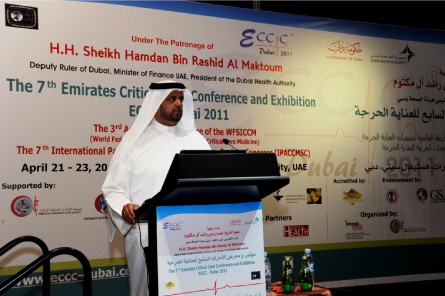
Al Murooshid highlighted the
importance of the
conference during his
opening speech and extended
his gratitude to His
Highness Sheikh Hamdan Bin
Rashid Al Maktoum, Deputy
Ruler of Dubai, UAE Minister
of Finance and President of
the DHA for sponsoring the
conference and for his
direction under which Dubai
has been able to advance the
level of health services and
expertise of its medical
professionals.
He said: “The convening of
this conference is of
particular importance,
because it brings together
international and national
experts in the field of
critical care to and
provides them with a
platform to discuss
state-of-the-art information
to help improve the standard
of critical care provided to
patients.
The DHA has always paid
great emphasis to this field
because we realize the
importance of management of
such cases and thus the DHA
has built various Intensive
Care Units( ICU’s) across
its hospitals, where we have
trained personnel,
state-of-the-art medical
equipment and this has
helped us reduce our
mortality rates in ICUs from
60 per cent to 35 per cent,
which is less than the
international bench mark of
40 to 50 per cent.”
Dr Hussain Nasser Al Rahma,
the President of the 7th
Conference of Emirates
Intensive Care Society,
President of the
International Pan Arab
Critical Care Medicine
Society , Chairman of the
Emirates Intensive Care
Society and head of ICU,
Dubai Hospital, said that
the field of critical care
is of great importance to
help alleviate the suffering
of trauma patients.
Dr Al Rahma said, “Critical
care is a fast advancing
speciality and is dependent
on highly skilled
professionals, latest
technology and integration
of services to achieve the
best patient outcomes and to
lower mortality rates.
Dubai is currently the
benchmark in this region and
one of the leaders in
critical care, we have the
latest equipment and skilled
medical staff and we
strongly focus on training
students and faculty in this
field.”
He highlighted that Dubai
Hospital is equipped with
the latest non-invasive
medical equipment that helps
gauge the complete status of
patients and immediately
identifies what is wrong
with the patient. “Such
sophisticated equipment and
highly skilled staff have
helped us provide
internationally recognised
levels of care to patients
and has reduced the risk of
mortality in our ICU’s”
Al Rahma said that although
Dubai is a benchmark in
terms of critical care, the
field is ever changing and
therefore holding such
conferences which brings
together esteemed healthcare
professionals including 50
Presidents from various
critical societies the world
over is of significant
importance.
Dr. Al Rahma said that the
conference objective was to
discuss ways of dealing with
emergency cases in intensive
care units in all medical
specialties, such as kidney
diseases, respiratory
diseases, neurological
diseases and brain injury.
Moreover, during the
three-day conference, Dr.
Edgar Jimenez, the President
of WFSICCM conducted a
demonstration in
communication with Orlando
Hospital campus in the
United States directly
through the Internet.
He demonstrated the use of
an automated doctor, known
as Robodoc, which basically
evaluates patients through
the use of high speed
internet. The system helps
diagnose the patient, review
his results and even
follow-up the case.
This automated doctor is
called Robodoc and is
considered one of the
innovations of Dr. Jimenez,
and is used in more than 12
U.S. states, many American
university hospitals as well
as in many hospitals in
Japan, Korea, Indonesia and
in Germany.
Dr. Edgar Jimenez, the
President of WFSICCM,
highlighted the use of
Robodoc and such latest
technology to advance
critical care.
In terms of this region, Dr
Jimenez said that the UAE is
a leading example for
providing advanced critical
care in the PAN ARAB
society. “ The UAE sets an
example in this region by
demonstrating the use of
sophisticated technology,
skilled medical staff and
integration to manage
critical care patients.”
Jean Daniel Chiche,
President Elect of the
European Society of
Intensive Care Medicine (
ESICM) said that keeping in
mind the changing
demographics the world over,
critical care will gain more
importance in the years to
come. “ In this region,
there is need to further
advance training facilities
and educational needs in
terms of critical care.
Another area of great
importance is to focus on
trauma patients, because
many of them are young
adults and can go back to
leading their lives
normally.”
Dr Khalid Shukri, Founder,
Past President and current
Secretary General of the
International Pan Arab
Critical Care Medicine
Society said, “ No matter
what the specialization is,
from cardiology to general
surgery and gynaecology,
when a patient is critically
ill, he is moved to the ICU
because that is where the
patient is monitored
continuously and provided
intensive levels of care.
Therefore the importance of
this field will only grow in
the years to come.”
Thirty countries
participated at the
conference including USA,
Chile, Colombia, Brazil,
Argentina, Belgium, France,
Germany, Spain, India,
Korea, China, Hong Kong,
Japan, the GCC countries,
Jordan, Syria, Lebanon,
Egypt, Algeria, Tunisia,
Morocco, Sudan and South
Africa.
 PRINT
THIS ARTICLE
PRINT
THIS ARTICLE
|