|
Healthcare leaders at
WHX map out Middle East
workforce strategy for 2030
and beyond
(DUBAI)
- The World Health
Organization (WHO) estimates
that a global shortage of 11
million healthcare workers
is projected by 2030.
Addressing this could
generate US$1.1 trillion for
the global economy, with the
McKinsey Health Institute
estimating that around $300
billion of that could be
from healthcare worker jobs.
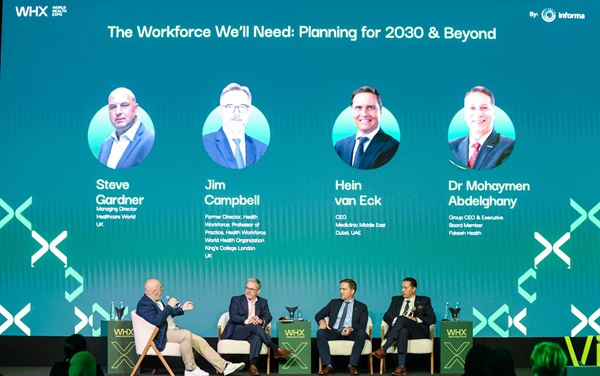
At the panel discussion
titled ‘The Workforce We’ll
Need: Planning for 2030 and
Beyond’ held at the
Healthcare Leadership forum
on the Visionary Stage
during
World Health Expo (WHX),
which takes place until
tomorrow, 12 February at the
Dubai Exhibition Center,
healthcare leaders addressed
how to build a sustainable,
high-quality healthcare
workforce for the next
decade.
Against this
backdrop of rising demand
and ageing populations in
many parts of the world, the
panel discussed how the UAE
can shift from a
recruitment-led model to one
that balances international
talent with strong local
pipelines.
Hein Van Eck, CEO of
Mediclinic Middle East,
Dubai, UAE,
explained that healthcare
systems risk losing critical
expertise in specialized
nursing, and that
understanding why staff
leave is key to improving
retention.
“It is
not a problem for us to get
skilled workers into the
system, but it is a problem
that we lose highly skilled
unit managers who are very
scarce to come by. We have
to acknowledge the fact that
they're not leaving for
money. They are leaving to
gain a passport for their
family and for future
generations. We need to
ensure that we always have a
strong pipeline growing, and
we demonstrate to them that
there is future career
progression. The push to
become self-reliant is
certainly there, so it is
moving in the right
direction."
Mohaymen Abdelghany, Group
CEO & Executive Board
Member, Fakeeh Health,
emphasized the need to
distinguish between
controllable and
uncontrollable attrition and
to act on areas within their
control. He pointed to
structured retention
strategies, alongside a
step-change in local
education and training
capacity, as the foundations
for long-term resilience.
Concrete examples, such as
the hundreds of students and
trainees already moving
through local programs,
illustrated how the region
is starting to turn strategy
into practice.
Jim Campbell,
Director, Health Workforce,
World Health Organization,
discussed how international
recruitment patterns and
education systems in
exporting countries affect
the future workforce. He
argued that linking
education to employment and
making universities anchor
institutions can help
countries like the UAE build
a balanced, sustainable
workforce model.
Looking ahead, he
highlighted Africa and other
fast-growing regions as key
partners in a thoughtfully
planned global workforce
strategy. He encouraged the
UAE to take a leadership
role in that conversation.
“There is a workforce
strategy being developed
currently in the UAE. It
started last year. It is the
first-ever federal strategy
looking at a 10-15-year
account. The UAE is the
first country to actually,
intentionally understand
labor economics and markets.
We have economic demand, but
a limited supply currently.
And, so, the intention
looked at the opportunity to
work with Africa and to work
with the diaspora,” he
added.
Across the
discussion, the panelists
converged on a clear
message: future-proofing the
healthcare workforce will
depend on a combination of
stronger domestic training
pipelines, targeted
retention strategies, and
responsible international
collaboration.
In
addition to the opportunity
to participate in expert-led
conversations across the
Healthcare leaders at WHX,
map out the Middle East
workforce strategy for 2030
and beyond, Future X, and
Frontiers Stages, WHX
attendees also had access to
CME-accredited conferences
to advance their careers.
Elsewhere on the conference
agenda at WHX today,
attendees explored a wide
range of clinical topics,
including the evolving role
of radiology in the modern
health system, artificial
intelligence in reproductive
medicine, new frontiers in
cancer care, and women
leaders driving technology
innovation.
Ross Williams, Commercial
Director, Informa Markets
Healthcare, said:
“Workforce strategy is
ultimately about people and
opportunity. At WHX, we
convene leaders to shape
long-term workforce planning
while also delivering
tangible educational
pathways through our
CME-accredited conferences,
leadership forums, and
specialist stages. These
platforms ensure healthcare
professionals at every level
are equipped for the demands
of 2030 and beyond.”
WHX continues through 12
February, at the Dubai
Exhibition Center.
 PRINT
THIS ARTICLE
PRINT
THIS ARTICLE
|