 |
|
|
 |
|
|


Consulting & Development
Health Care (Germany)

|
|
|
|
|
|
|
|
|
|
|
|
|
|
| |
Medical
News | Saturday, 16 February, 2008 |
|
|
| |
 |
|
|
|
|
|
|
Research
team identifies novel anti-cancer
drug from the sea
|
|
|
|
|
|
|
|
|
(ArabMedicare.com
News) -- A collaborative
team of researchers
spearheaded by Dennis Carson
M.D., professor of medicine
and director of the Rebecca
and John Moores UCSD Cancer
Center at the University of
California, San Diego (UCSD)
has identified a potent new
anti-cancer drug isolated
from a toxic blue-green
algae found in the South
Pacific. The properties of
somocystinamide A (ScA) are
described in a paper that
was published online in
Proceedings of the National
Academy of Science the week
of February 11 -15.
"We are excited because
we have discovered a
structurally unique and
highly potent
cancer-fighting
compound," said Dwayne
G. Stupack, associate
professor of pathology at
the Moores UCSD Cancer
Center. "We envision it
will be perfect for emerging
technology, particularly
nanotechnology, which is
being developed to target
cancerous tumors without
toxic side effects."
The ScA compound was found
in the cyanobacteria L.
Majuscula, also known as
"mermaid's hair,"
gathered off the coast of
Fiji in the South Pacific by
the laboratory of William
Gerwick at Scripps
Institution of Oceanography.
A diverse team of
researchers from UCSD's
Cancer Center, School of
Medicine, Skaggs School of
Pharmacy and Pharmaceutical
Sciences, and Scripps worked
to identify, screen and test
marine compounds in vitro
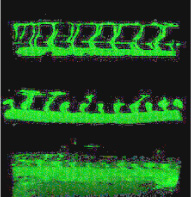
and in vivo. They found that
ScA inhibits
neovascularization, the
formation of blood vessels
that feed tumors, and also
had a direct impact on tumor
cell proliferation.
"The compound isn't
toxic to the cyanobacteria
itself, but activates a
'death pathway', present in
our cells," said
Stupack. "When the
cells of the blood vessels
that feed tumors become
activated and proliferate,
they become especially
sensitive to this
agent."
Gerwick noted that if a
normal-sized swimming pool
full of cancer cells were
treated with ScA, it would
take only three milligrams -
about the weight of a grain
of rice - to kill all of the
cancer cells.
Wolf Wrasidlo, Ph.D., senior
project scientist at the
Moores UCSD Cancer Center
and first author of the
work, added that the unique
structure of this compound
lends itself very well to
nanotechnology, because it
"incorporates
spontaneously" into
molecule-sized nanoparticles,
important for the kind of
highly targeted, combination
therapy being developed to
treat cancer. The structure
is also simple enough that
the scientists can reproduce
it.
"ScA is the first, and
most potent compound we've
identified so far,"
Stupack said, adding that it
won't be the last, as the
Scripps team has identified
more than 250 unique
compounds from L. Majuscula
alone. "But we don't
yet know how abundant ScA
is, or if it's feasible to
harvest, so it is important
that we have been able to
produce this natural product
in the lab."
The research was funded by
grants from the National
Cancer Institute (USA), as
well as fellowships from the
National Swiss Foundation
and California Breast Cancer
Research.

Posted:
16/FEB/08
|
|
|
|
|
|
|
|


